
Crowd preference
How many other tourists is too many?
Best months for atmosphere without overwhelming crowds
Athens — meaningfully fewer visitors than peak, but the destination is fully open and operating normally. Good balance of atmosphere and accessibility.
Best Time to Visit Athens 2026: Skip the 40°C August Heat
Athens is one of the oldest cities in the world and the birthplace of Western civilisation - a capital city where ancient Greek history layers over Byzantine churches, Ottoman mosques, and neoclassical boulevards in a density that no other European destination matches. The Acropolis, the Parthenon, the Ancient Agora where Socrates argued philosophy: these are the foundations of the culture that shaped the modern world. Experiencing them properly requires timing your visit carefully.
The case for shoulder seasons in Athens is stronger than almost any other European destination. August on the Acropolis main entrance queue can stretch to two hours in temperatures exceeding 40°C on exposed limestone with almost no shade. April and October deliver the same ancient ruins, the same breathtaking views, the same rooftop bars overlooking the Parthenon - at 20–25°C with a fraction of the visitors.
Athens in April & May: Ancient Ruins in Perfect Conditions
April is arguably the finest month to visit Athens. Temperatures of 20–22°C are ideal for the extraordinary amount of walking the ancient city rewards. The Acropolis hill has spring wildflowers growing from the rock between the stones - something the summer heat burns away entirely. The combined ticket, covering the Acropolis, the Ancient Agora, the Roman Agora, Hadrian's Library, and four other significant sites, gives you five days to explore ancient Athens at a pace that does it justice.
The Athens Festival (Hellenic Festival) begins in May and runs through October, filling the Odeon of Herodes Atticus - a 2nd-century Roman theatre on the south slope of the Acropolis - with opera, ballet, and classical music performances. Watching a performance in this space, with the floodlit Parthenon directly above and the Aegean Sea visible in the distance, is one of the defining travel experiences in Europe. Tickets sell out for major productions; book as soon as the programme is published.
Spring Athens Highlights
- Athens & Epidaurus Festival (May–October): The Odeon of Herodes Atticus programme launches in May - secure tickets early for headline performances.
- Wildflowers on the Acropolis hill: April brings colour to the ancient rock that summer heat eliminates entirely.
- Panathenaic Stadium in spring: The marble stadium that hosted the first modern Olympic Games in 1896 is beautiful in morning light and rarely crowded in April.
- Athens Riviera: By May, the coastal road south of the city (Vouliagmeni, Varkiza) is warm enough for swimming and the beach clubs are open without August crowds.
Athens in October & November: Golden Light on Ancient Stone
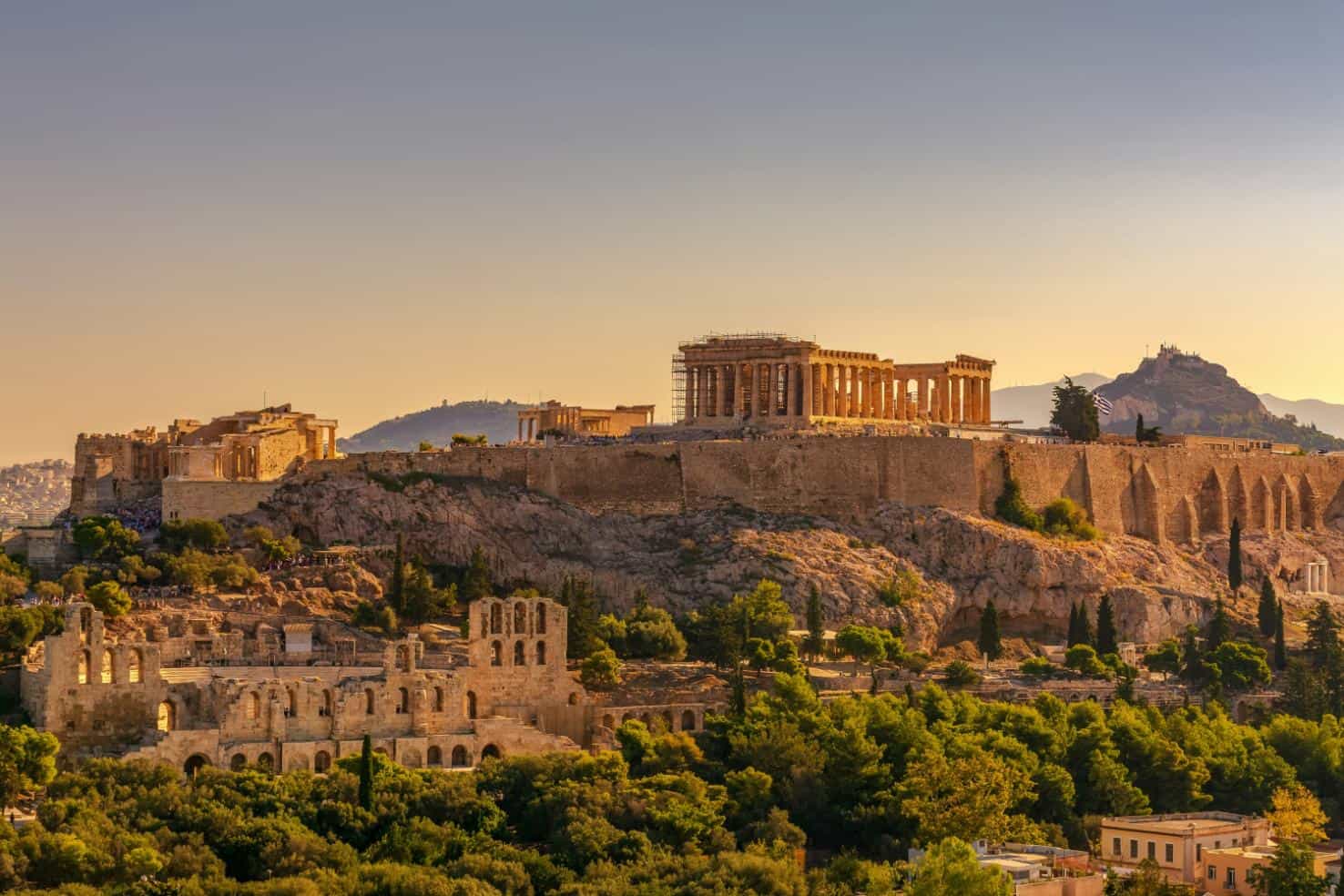
October may be Athens's most beautiful month. The light shifts lower and warmer, and the Parthenon's Pentelic marble - which glows white in summer - turns a deep honey gold in the autumn afternoon sun. Temperatures remain warm (22–25°C) well into October, making rooftop bar culture, outdoor dining in the narrow streets of Monastiraki and Psiri, and the walking distances between ancient monuments entirely comfortable.
The summer tourists have departed. Monastiraki Square and the flea market surrounding it return to their actual character - a neighbourhood commercial centre with small shops selling everything from antique furniture to fresh fish, rather than the tourist-dense experience of August. The Sunday flea market expands into the surrounding streets and is genuinely one of the great free experiences in Europe: furniture, military surplus, vinyl records, and the best people-watching in the Greek capital.
The Athens Marathon in November follows the original course from the burial mound at Marathon to the Panathenaic Stadium in central Athens - the route that the first modern Olympic Games commemorated in 1896. Open to participants, extraordinary atmosphere for spectators at both ends of the course.
The Acropolis & Parthenon: Making the Most of the Visit
The Acropolis is non-negotiable - it is the defining monument of ancient Greek civilisation and one of the most impressive views in the world. But how you visit matters enormously. The Acropolis main entrance faces west; arriving at opening time (8am in shoulder season) means the morning light is behind you and the queues are a fraction of midday. By 11am in shoulder season and 9am in July–August, the site fills rapidly.
The Parthenon, the Erechtheion (with its Caryatid porch), the Temple of Athena Nike, and the Propylaea gate are all within a short walking distance of each other on the summit plateau. The views from the south wall - over the Odeon of Herodes Atticus, across the ancient city, to the Aegean Sea on clear days - are genuinely breathtaking. Allow 2–3 hours for the site.
The Acropolis Museum at the base of the hill is world-class and not to be skipped. The original sculptures - the Caryatids from the Erechtheion, the Parthenon frieze panels that remain in Athens (others are controversially in the British Museum) - are displayed on the third floor with the Acropolis visible through the glass roof above. The building itself, with a glass floor over excavated ancient Athens beneath your feet, is extraordinary.
Ancient Athens Beyond the Acropolis
The combined ticket covers some of the most significant ancient ruins in the world beyond the Acropolis hill - and they are systematically undervisited by tourists who exhaust themselves at the main site and miss what surrounds it.
The Ancient Agora was the commercial centre and civic heart of ancient Athens - where Socrates taught, where democracy was debated, and where the ancient city's daily life played out. The Temple of Hephaestus on the western hill is the best-preserved ancient Greek temple in the world (better preserved than the Parthenon) and deserves at least 30 minutes. The Stoa of Attalos, a reconstructed ancient shopping colonnade now housing the Agora Museum, contains extraordinary finds from 5,000 years of Athenian history.
The Roman Agora, a stone's throw from the Ancient Agora, contains the extraordinary Tower of the Winds - an 1st-century BC clocktower with eight faces each carved with a god representing a wind direction. Hadrian's Library, the enormous complex built by the Roman Emperor adjacent to the Agora, gives a sense of the scale of Roman Athens. Hadrian's Arch, the gateway marking the boundary between ancient Athens and the Roman city, stands at the eastern end of the ancient city at walking distance from everything.
The Temple of Olympian Zeus (Olympieion) - the largest temple ever built in ancient Greece, dedicated to Zeus and completed by Hadrian in 131 AD - is extraordinary even in its incomplete state. Fifteen of the original 104 columns remain standing; one column lies fallen exactly where it collapsed in a 1852 storm, giving a sense of the enormous scale of the original structure.
The Combined Ticket - What's Included
- Acropolis & Parthenon - the defining monument of ancient Greek civilization
- Ancient Agora - the civic heart of ancient Athens, with the best-preserved Greek temple in the world
- Roman Agora & Tower of the Winds - Roman Athens, adjacent to the Ancient Agora
- Hadrian's Library - enormous Roman complex, free with the combined ticket
- Temple of Olympian Zeus - largest ancient Greek temple, 15 surviving columns
- Kerameikos Cemetery - ancient Athens's principal cemetery, extraordinary funerary sculpture
- Theatre of Dionysus - the world's first theatre, birthplace of Greek drama
- Lykeion - Aristotle's school, recently excavated
The Hills of Athens: Lycabettus, Philopappos & the Views
Athens is a city of hills, and the views from the higher ground explain the city's geography in a way that no map can. Lycabettus Hill (277m) is the highest point in central Athens - reachable by funicular or a 20-minute climb through the pine forest - with a 360° view over the entire city, the Acropolis below, the Aegean Sea, and on clear days the mountains of the Peloponnese. The terrace café at the summit serves overpriced coffee that is worth paying for the view alone.
Philopappos Hill, opposite the Acropolis across the Dionysiou Areopagitou pedestrian boulevard, gives the most famous Acropolis view - the postcard shot looking across to the Parthenon. The path through the pine trees is well-maintained and takes 20 minutes to the summit. The ancient monument at the top is the Philopappos Monument, built in 114–116 AD.
The rooftop bars and restaurants of the hotels surrounding the Acropolis - concentrated in the Monastiraki, Thissio, and Koukaki neighbourhoods - provide the same Acropolis view at sunset with a drink in hand. The A for Athens hotel rooftop bar and the Couleur Locale bar in Monastiraki Square are the most famous; in shoulder season, arriving without a reservation is possible where summer requires booking weeks ahead.
Athens Neighbourhoods Worth Exploring
Monastiraki and the flea market extending from Monastiraki Square into the surrounding streets is Athens at its most chaotic and most interesting. The square itself - with the ancient Monastiraki Mosque, the Tsisdarakis Mosque (now a ceramics museum), and the Acropolis visible above - has a density of historical layers extraordinary even by Athenian standards. The Sunday flea market is the city's great free weekly experience.
Syntagma Square is the modern city's centre - the Greek Parliament (the former Royal Palace) faces the square, and the Changing of the Guard ceremony at the Tomb of the Unknown Soldier is performed every hour on the hour with full Evzone uniform. A prime location for orientation when arriving; less interesting for extended exploration.
Exarcheia is Athens's anarchist and student neighbourhood, adjacent to the National Archaeological Museum. Covered in extraordinary street art, politically charged, and home to some of the best tavernas and natural wine bars in the city. Rough around the edges and entirely authentic - a different city from the tourist layer of the ancient centre.
Koukaki and Mets, immediately south of the Acropolis, are the gentrifying residential neighbourhoods where Athenians actually eat and drink - excellent independent coffee shops, neighbourhood restaurants with handwritten menus, and the general atmosphere of a picturesque neighbourhood that hasn't been entirely overtaken by tourism.
Psiri, between Monastiraki and the ancient centre, has narrow streets lined with mezedhopolia (small plates restaurants), live music venues, and bars that fill from 10pm. The creative energy of this neighbourhood makes it Athens's best area for an evening out.
Eating in Athens: From Street Food to Mezedes
Athens's food culture is built around mezedes - small shared plates that arrive in waves alongside wine or ouzo. The traditional taverna format (ouzo with octopus, taramasalata, horiatiki with proper feta cheese chunks, then grilled fish) represents some of the finest eating in Europe at prices that remain reasonable even as the city has become more expensive. The tourist-facing restaurants of Plaka (the neighbourhood immediately below the Acropolis) are almost uniformly mediocre; the identical food is better and cheaper in Koukaki, Exarcheia, or Mets, within easy walking distance.
Athens is a city for food lovers prepared to walk away from the obvious. The Varvakios Central Market (Athens Central Market) near Monastiraki Square is the city's wholesale food market - the meat hall, the fish hall, and the spice and olive vendors surrounding it are extraordinary on a weekday morning. The Panathenaic Stadium area in Mets has several neighbourhood restaurants that serve lunch to the local community at prices that have nothing to do with tourism.
Athens Food Essentials
- Souvlaki: Kostas in Monastiraki Square - the benchmark, pork skewers in pitta with tomato and onion for €3. Queue moves fast.
- Spanakopita / tiropita: From any bakery in the morning for €1.50–2 - spinach-feta or cheese pastry, genuinely excellent.
- Ouzo and mezedes at a traditional ouzeri: The classic Athens afternoon ritual - small plates of octopus, taramasalata, fried courgette, and grilled halloumi with anise-scented ouzo. Cheaper in Piraeus port than central Athens.
- Feta cheese: PDO Greek feta from a traditional taverna or market is entirely different from the supermarket equivalent - creamy, complex, brined properly.
- Athens Riviera seafood: The coastal suburb restaurants south of the city (Glyfada, Vouliagmeni) serve excellent fresh fish in a setting that makes the 30-minute tram journey worthwhile.
Getting Around Athens
The Athens Metro (three lines) and tram connect the city's main points efficiently. A day pass (€4.50, valid for 24 hours on all public transport including Metro, tram, and bus) provides unlimited travel and excellent value for a day of sightseeing across central Athens. The Metro Line 3 connects Athens International Airport to Syntagma Square in the city centre in 40 minutes - always use this over a taxi from the airport.
The area between Syntagma Square, the Acropolis, the Ancient Agora, Monastiraki Square, and the Kerameikos cemetery is entirely walkable - most major sites are within 15–20 minutes on foot of each other. The pedestrianised Dionysiou Areopagitou boulevard running along the south side of the Acropolis hill connects the major archaeological sites in a pleasant walking route with impressive views upward toward the Parthenon throughout.
For island-hopping from Athens, Piraeus port is 30 minutes by Metro Line 1 from Monastiraki. Ferries to the nearby islands of the Saronic Gulf (Aegina, Hydra, Spetses) run throughout the day and can be done as day trips. Ferries to the Cyclades (Santorini, Mykonos) and further Aegean Sea islands require planning around ferry schedules and accommodation.
Day Trips from Athens
Cape Sounion (70km south, 1.5 hours by bus) has the Temple of Poseidon perched on a cliff above the Aegean Sea - one of the most dramatically sited ancient monuments in Greece. Lord Byron carved his name into one of the columns in 1810. Sunset here is extraordinary.
Delphi (2.5 hours by bus) is the sanctuary of Apollo where the Oracle held court - one of the most important religious sites of ancient Greek civilization, set in mountain landscape above the Gulf of Corinth. A full day minimum.
Epidaurus (2.5 hours) has the most perfectly preserved ancient theatre in the world - the acoustics, tested by dropping a coin on the circular stage and listening from the back row, are genuinely extraordinary. The Athens & Epidaurus Festival uses this theatre for summer performances on weekend evenings.
The nearby islands of the Saronic Gulf - Aegina (30 minutes by hydrofoil), Hydra (90 minutes, no cars allowed), and Poros - each offer a glimpse of island life that, in shoulder season, retains its whitewashed houses and narrow streets character without the high-season pricing.
Also Consider
Pairs well with, or alternatives worth comparing:
Wondering how much you actually save in shoulder season? Our Shoulder Season Price Report analyses hotel prices across 110 destinations - flights are 37% cheaper, hotels drop 20–50%, and September is the world's most valuable travel month.
Frequently Asked Questions About Visiting Athens
- When is the best time to visit Athens? April–May and October–November are the shoulder season sweet spots. Spring brings wildflowers on the Acropolis hill and comfortable temperatures of 20–25°C; autumn keeps that warmth longer and adds the golden light that makes the Parthenon marble glow. Both windows are significantly cheaper than the summer peak and far less crowded.
- Is Athens too hot in summer? August in Athens regularly hits 38–40°C. The Acropolis is exposed limestone with almost no shade - sightseeing in that heat is genuinely uncomfortable and for some visitors dangerous. April, May, and October offer the same ancient ruins, the same rooftop bars and views, at temperatures that allow you to actually enjoy them.
- What is the combined ticket for the Acropolis? The combined ticket (€30 in peak season, €15 in winter) covers the Acropolis and Parthenon, the Ancient Agora, the Roman Agora, the Kerameikos cemetery, the Temple of Olympian Zeus (Olympieion), the Theatre of Dionysus, Hadrian's Library, and the Lykeion. Valid for five days - extraordinary value for anyone interested in ancient Greek history.
- How do I get from Athens International Airport to the city centre? The Metro Line 3 connects Athens International Airport directly to Syntagma Square in central Athens in approximately 40 minutes (€10.50). The express bus (X95) takes 60–90 minutes and costs €6.50. Taxis to the city centre cost €40–55 depending on time of day - the fixed-rate system means no surprises.
- Can you island-hop from Athens? Yes - Piraeus port, 30 minutes from Syntagma Square by Metro Line 1, has ferries to the Cyclades (Santorini, Mykonos, Naxos, Paros), the Aegean Sea islands, and Crete. May and September are ideal for island hopping - warm enough for swimming, ferries fully operational, and prices well below the July–August peak.
- Is the Acropolis Museum worth visiting? Absolutely - it's world-class. The original sculptures from the Parthenon are displayed in context on the third floor, with the Acropolis itself visible through the glass ceiling above you. The museum is free on the first Sunday of the month (October–March) and every Sunday from 5pm (April–October). Allow two hours minimum.
Ready to Book?
May is one of the best times to visit Athens. Compare prices now:
We may earn a small commission on hotel bookings at no extra cost to you.
This destination is great for:
Athens is featured in: